Stand on a plain in central Australia, the Nigerian savannah or the Namib desert and you may see something strange: flat ground in every direction, then a single mass of bare rock rising from it like a whale surfacing. Geologists call these inselbergs, from the German for "island mountain". The name fits, but it hides the interesting part. Most inselbergs were never pushed up at all. They are simply the pieces of a landscape that erosion could not remove, left standing while everything around them was carried away.
An inselberg is an isolated residual hill that rises abruptly from a plain of low relief. That plain might be a desert floor, a savannah, a weathered plateau surface or a coastal flat. What matters is the contrast: steep, often bare rocky flanks standing against ground that is otherwise stubbornly level.
They range in size from a few metres high to several hundred metres, and in shape from smooth domes and rounded whalebacks to blocky towers and short ridges. You will meet several overlapping words for them, and it helps to know which is which:
Inselberg is the umbrella term. If you are being careful, use it for the large, isolated, steep-sided version and reserve tor for the small ones perched on a plateau.
Erosion is not a uniform sheet sanding everything down at the same rate. Rain, rivers, groundwater and daily temperature swings attack rock according to how easily water can get in and how readily its minerals break down. Where a plain is underlain by rock of varying strength, the weak patches lower faster and the stronger patches become relative highs.
An inselberg is not a mountain that was pushed up. It is a patch of rock that was left behind.
As the surrounding surface keeps dropping, the resistant patch turns from a gentle bump into a hill, and eventually into an island of rock surrounded by flat ground. The hill itself hardly changes. The landscape around it does all the work.
Three factors do most of the deciding.
Rock is almost never solid. It is cut by joints and bedding planes, and every one of those cracks is a doorway for water. A mass with widely spaced joints lets very little water inside, so chemical weathering barely gets started. Many classic inselbergs are made of massive, poorly jointed compartments of granite or gneiss surrounded by heavily fractured rock of the same age.
Quartz resists chemical attack almost indefinitely. Feldspars and micas do not: they alter to clay when water and mild acids get at them. A quartz-rich rock therefore weathers slowly, while a rock rich in feldspar can rot in place. Sandstone cemented with silica is tough; sandstone with a weak clay cement crumbles quickly.
How the layers lie matters as much as what they are made of. A gently dipping bed of resistant quartzite or arkose can cap a hill and protect the softer rock beneath it. A vertical dyke of hard igneous rock can stand up as a wall while the rock on either side is worn down.
Many inselbergs are not simply tough from the start. They are the product of two separate episodes, which is why they are so common in the seasonally wet tropics.
Repeat that cycle and you get plains studded with similar domed hills, all made of the same rock, all with steep sides and rounded tops. Some inselbergs do form in a single stage, where a hard bed simply resists from day one. Both routes produce the same result, and field geologists have to work out which one applies.
Beginners often mix them up with fault blocks, volcanic plugs or the eroded stumps of fold mountains. A few checks usually settle it:
If the hill sits on a fault line, has a crater or a lava flow on top, or belongs to a long ridge of folded strata, you are looking at something else.
Uluru and Kata Tjuta in central Australia are the famous examples. Sugarloaf Mountain in Rio de Janeiro is a granite-gneiss bornhardt rising straight from the city and the sea. The Namib Desert is full of them, and they are a defining feature of savannah landscapes across Nigeria, Zimbabwe, Mali and Tanzania. Zuma Rock near Abuja is a striking example that many travellers pass without realising what they are looking at.
Britain works at a smaller scale. The tors of Dartmoor, Bodmin Moor and the Cairngorms are miniature inselbergs, formed by deep weathering followed by the stripping of the rotten rock. Limestone tower landscapes in Guilin in China and the mogotes of Cuba are the karst equivalent: same principle, different chemistry.
If you want to make sense of one for yourself, start with the contact between the bare rock and the plain. Is the change sharp? Then look at the joint spacing on the flanks: wide spacing supports the idea that the mass survived because water could not get in. Note whether the rock is quartz-rich, and check a geological map to see whether the hill sits on a different unit from the surrounding plain.
Sketch the profile from a distance, mark where the slope angle changes, and look at the debris at the base. Early morning or late afternoon light shows the shape far better than midday sun. None of this needs specialist kit: a notebook, a hand lens and a map will take you a long way. The reward is a landscape that stops being background and starts reading as a record of what was removed, and what happened to be left standing.
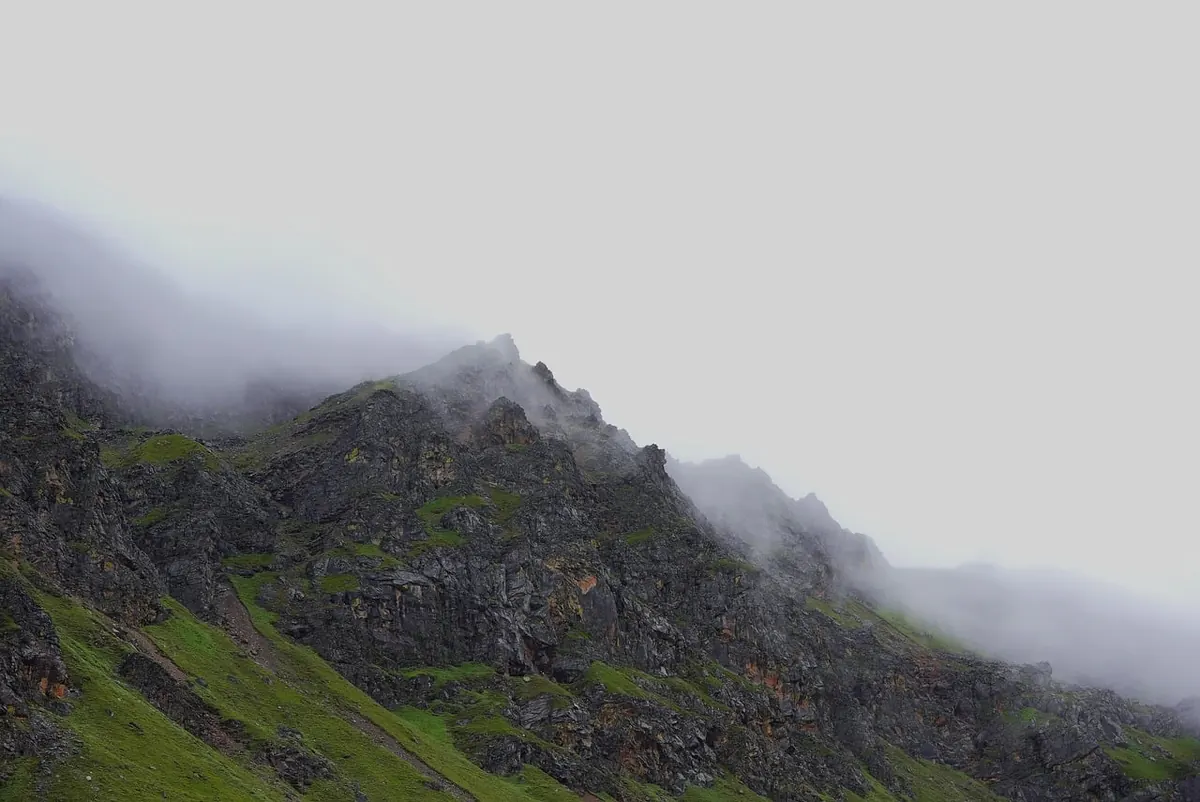
Photo: su2e3t / Pixabay